In open source, the code is the cheap part
Agents can rebuild a code base from its test suite. They can't copy the people who answer for it.
In February, Cloudflare rebuilt most of the Next.js API in about a week, for about $1,100 in tokens. The spec was Next.js's own test suite. Within days, security researchers reported two dozen vulnerabilities in the rebuild, in code that had passed its functional tests.
Both halves of that story matter. The first says the code base isn't the moat anymore. The second says what is.
A test suite is a spec
If a test suite is enough to rebuild a project, anyone with a token budget can have the code. People who run open source companies say so themselves. Dries Buytaert, who started Drupal: "AI can ship a specification but it can't run a business." Florian Forster, CEO of Zitadel: "What we actually sell these days is risk transfer."
What didn't copy was the years of fixes behind the original, made by people who still answer when something breaks. Ruohang Feng put it well, writing about an AI port of Postgres: "You can copy the exam. You cannot copy the examiners."
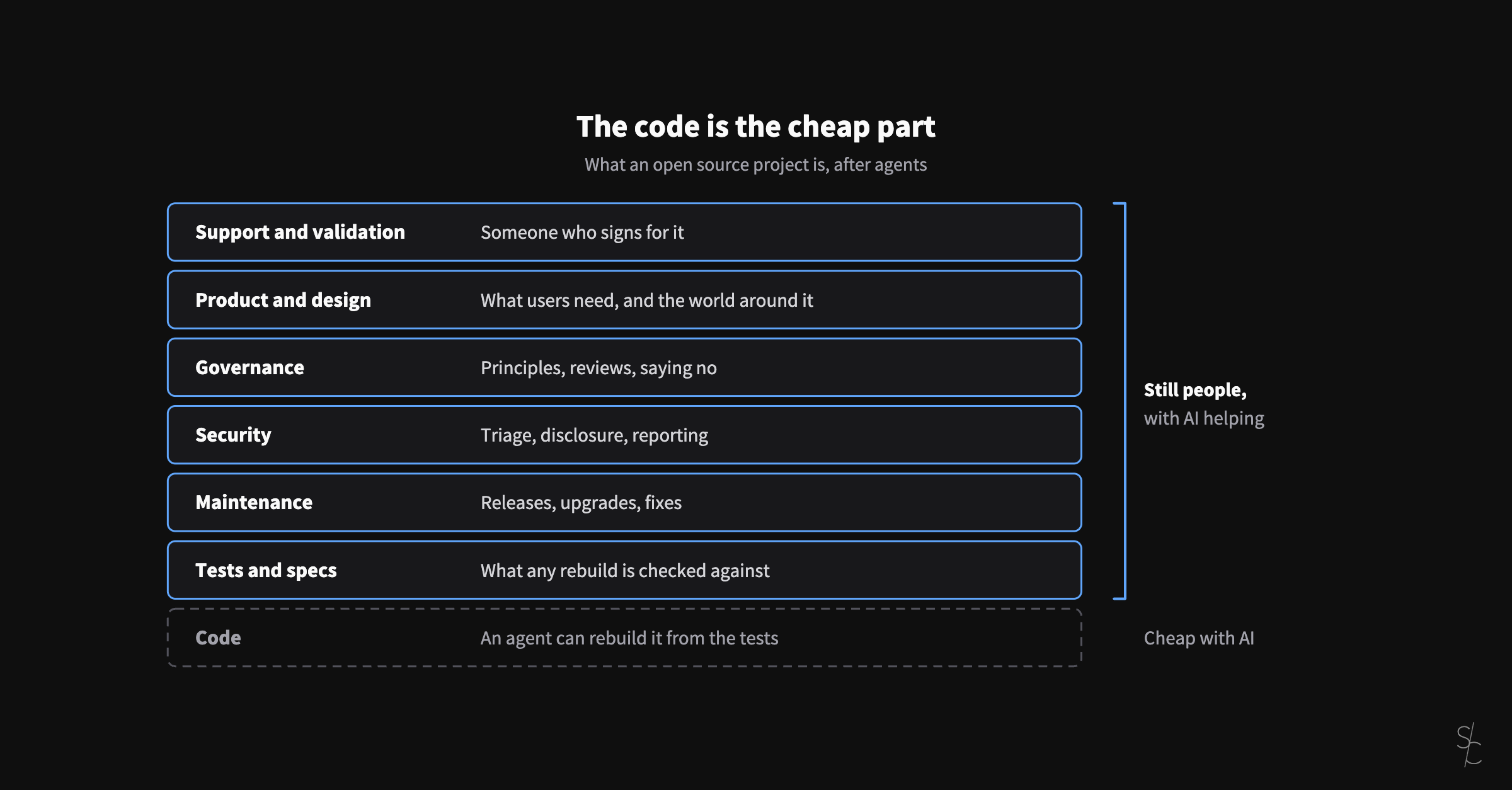
So the services around the code matter more than the code. But the best of them, knowing what to fix and what to refuse, come from the people who know the code. They aren't a layer on top. They're the project.
Someone has to know what it's for
A test suite is a spec, but someone had to write it. Someone had to know what the software is for, who uses it, and what happens around it that no test describes. An agent can draw a screen in minutes. It can't stand next to the person using it.
Andrew Ng wrote last year that "deciding what to build is the new bottleneck", and that the people who get past it have high user empathy. In business software I'd go further. Much of what decides the design isn't in the software at all.
Software is usually one step in a longer process. An order goes through picking, packing, shipping and an invoice, and touches several other systems on the way. A good design fits what happens before and after the screen, the constraints nobody wrote down, and the workarounds people built because the last system didn't fit: the spreadsheet next to the ERP, the note taped to the scanner, the person entering data with gloves on. None of that is in the repository.
That's the work of product engineering, service design and UX. AI helps here too. It turns an idea into a prototype in an afternoon and reads a hundred support tickets in minutes. But it only knows about the warehouse what someone wrote down. Someone still has to go there.
Open source has an edge here. Its users report problems in public, in their own words. An issue is user research nobody had to schedule.
Maintenance got cheaper, not cheap
AI lowers the cost of keeping code safe. In DARPA's AI Cyber Challenge, automated systems found 54 of 63 planted vulnerabilities and patched 43. One researcher's AI-assisted reports to curl led to 22 fixes.
The same tools make noise. In January, curl ended its bug bounty after the share of confirmed reports fell below 5%. Finding a bug got cheap. Checking a report didn't. About half of the 13,000 most downloaded npm packages are maintained by one person, and that person still reads every report. In March the Linux Foundation announced $12.5 million in grants aimed at that flood of AI-generated reports.
Fork it, or send it back
What I like about open source as a user is that nobody has to wait. If a library almost fits, you can change it. Agents make that cheaper than ever: an afternoon to add the feature you need to someone else's code.
Carrying a fork is still the expensive path. An agent writes the first version in an afternoon, but every upstream release after that has to be merged again. Valkey, the Redis fork, drew 150 active contributors in its first year, and one of its maintainers said she was burned out after the first six months.
So sending the change back is still cheapest, if upstream takes it. That's getting harder. In February, GitHub added settings to turn off pull requests or limit them to collaborators. In a 2024 Tidelift survey, 64% of maintainers said they were less inclined to accept pull requests from contributors known to use AI. The change that gets in is the one written by someone with the setup to test it, against criteria the project wrote down.
Contributors follow users
Open sourcing a project is supposed to bring help with hardening and new features. Sometimes it does. Mostly it doesn't. Of the 11.8 million projects ecosyste.ms tracks, about 7 million have one maintainer. Contributions follow use, not a license.
Agents may make that worse. Tailwind CSS is used more than ever, but in January its company said docs traffic was down about 40% and revenue close to 80%, and three quarters of its engineering team lost their jobs. One company isn't a trend, but the mechanism is easy to see. A developer who asks an agent never visits the docs, so they never see what the project sells or where to report what they found.
The contributions that do arrive are worth a lot, because they come from systems the maintainers can't reach. No maintainer can test every setup. Users can.
Governance is a job, and AI is a coworker in it
Governance used to mean deciding things in issue threads. Now it also means writing the decisions down where agents read them, because more and more pull requests are written by one. AGENTS.md, a file that tells coding agents how a project works, is used by more than 60,000 open source projects. Each rule written down once is a review nobody repeats by hand.
GitHub Next measured an automated maintenance agent across 13 repositories: issues closed about eight times faster and pull requests merged about ten times faster. The deciding factor, in their words: "The rate at which human maintainers decide to act." The agent proposes. A person decides.
Where I think this goes
More open source. In 2025, 121 million new repositories went up on GitHub and 36 million new developers joined. Most of those repositories are small. But publishing a tool for a niche costs almost nothing now, so more niche tools get published.
More open business software. I expect more ERP, MES and WMS for specific industries and functions to be built in the open. Some already is. ERPNext, fully open source since 2011, has more than 40,000 GitHub stars, and its company sells the hosting. Odoo is valued at €10 billion. It won't be pure open source, though. Odoo is open core, with paid parts under a commercial license, and a regulated manufacturer still wants a vendor who signs for validation. So I'd expect open code sold with hosting, support, validation, and people who know the industry. That's the services argument again.
Maintenance as its own business. This one is already happening. Chainguard is valued at $3.5 billion and has started maintaining abandoned projects like ingress-nginx. HeroDevs raised $125 million to keep supporting versions their maintainers have retired. And the EU Cyber Resilience Act, which applies in full from December 2027, names a role for it: the open-source software steward. So far the money goes to security vendors rather than independent governance firms. But the demand is now written into law.
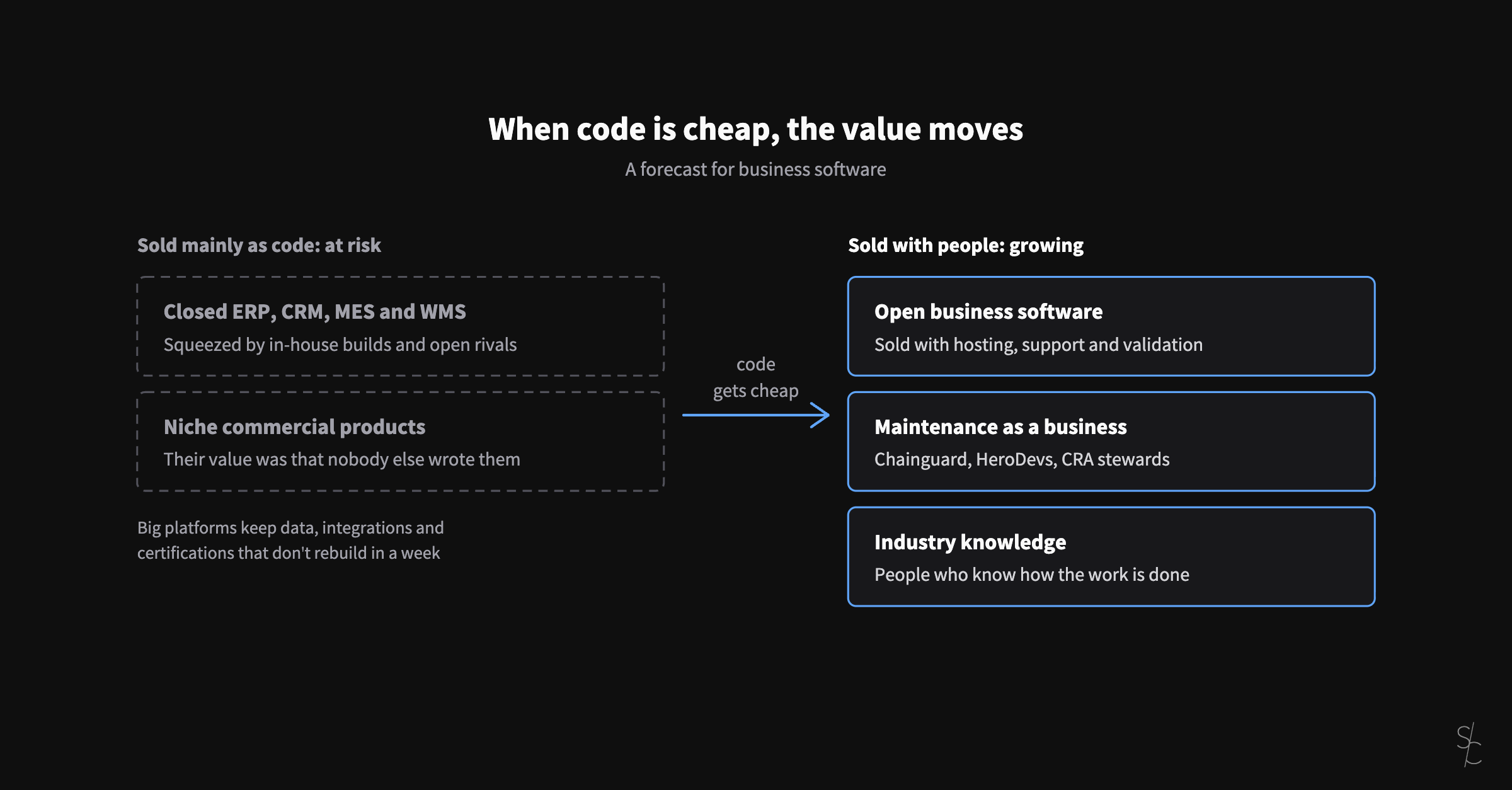
Pressure on closed business software. If the code is cheap, the vendors who mainly sell code are exposed: closed ERP, CRM, MES and WMS, and niche commercial products whose main value is that nobody else wrote them. In McKinsey's 2026 survey, 32% of respondents said their organization had decided against buying at least one software product or feature because it could build it with coding agents. Investors got there first. After Anthropic released industry plugins for Claude Cowork in January, software stocks lost about $1 trillion in two weeks, Salesforce and SAP among them. The big platforms have data, integrations and certifications that don't rebuild in a week. A niche product with a hundred customers has less to stand on. Its best defense is the same as open source's: people who know the industry, and someone who signs for it.
Someone who answers
Cloudflare's rebuild took a week. What it couldn't copy was the years of decisions behind the original: which reports matter, on which systems, and what to refuse.
Open source used to be a gift of code. Now the code is the cheap part of the gift. The rest is people: someone who knows what the users need, and someone who answers.
Links
On the code getting cheap:
- Cloudflare: How we rebuilt Next.js with AI in one week
- Hacktron: vinext: Vibe-Hacking Cloudflare's Vibe-Coded Next.js Replacement
- Dries Buytaert: AI is a business model stress test
- Florian Forster, Zitadel: Open Source in the AI Era, why Risk Transfer Became the Product
- Ruohang Feng: Did AI Rewrite PostgreSQL in Rust? Not Quite
On deciding what to build:
- Andrew Ng, The Batch: How to Get Through the Product Management Bottleneck
On maintenance, contributions and governance:
- DARPA: AI Cyber Challenge marks pivotal inflection point for cyber defense
- Daniel Stenberg: The end of the curl bug bounty
- Josh Bressers: Open Source is one person
- The Register: A year on, Valkey charts path to v9 after break from Redis
- GitHub: New repository settings for configuring pull request access
- Adam Wathan on Tailwind's layoffs: tailwindcss.com pull request 2388
- AGENTS.md
- Don Syme, GitHub Next: The Impact of Automated Repository Maintenance Assistance
On where it goes:
- GitHub: Octoverse 2025
- Brussels Times: Odoo announces €10 billion valuation
- ERPNext: github.com/frappe/erpnext
- Chainguard: Introducing Chainguard EmeritOSS: Sustainable stewardship for mature open source
- HeroDevs: $125 million strategic growth investment from PSG
- McKinsey: The state of AI in 2026
- ACS Information Age: New AI tools tank software stocks
- OpenSSF: CRA open-source stewards one-pager
More from the blog
We still price software with a pre-agentic cost model
Five prices in software changed at once. Building got cheap. Checking didn't.
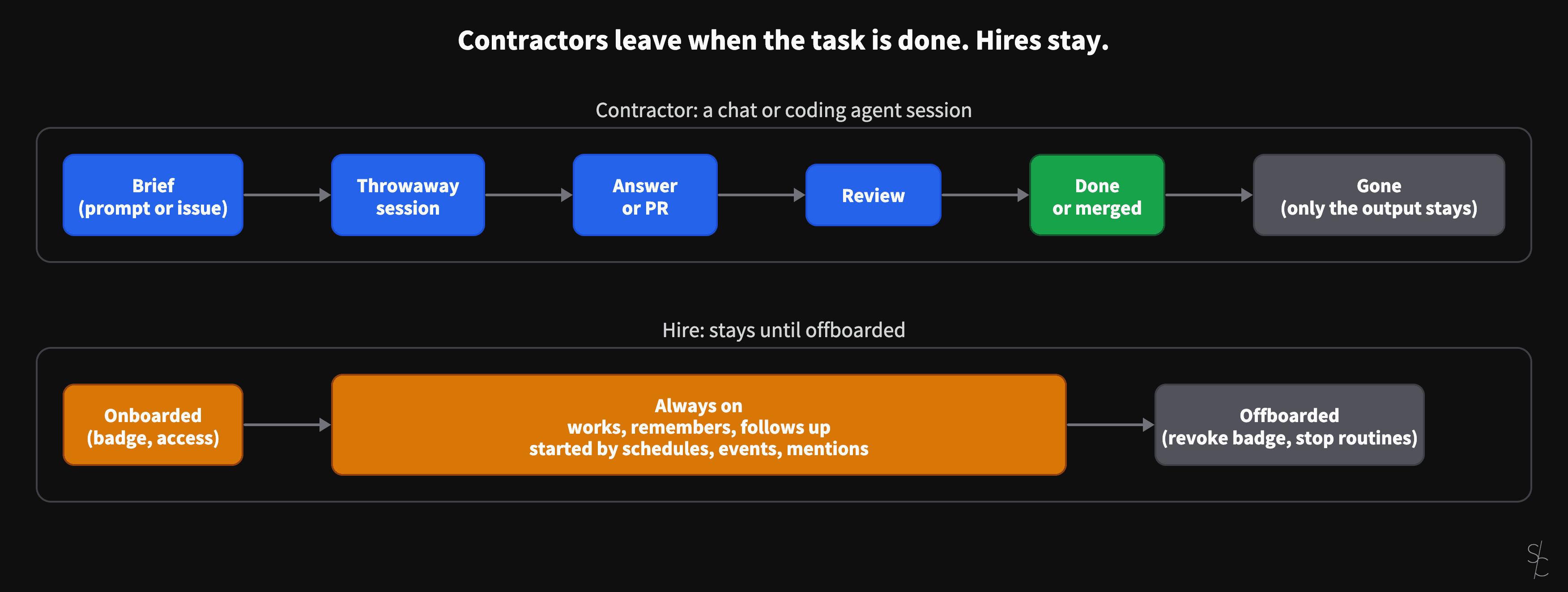
AI sessions are contractors. Always-on agents are hires.
A chat or a coding agent session ends when the task is done, when the answer is given or the PR is merged. Grok Bot and OpenAI's dots stay. That changes what you have to give them.
Eight months of an MCP server for Db2 for i
In January the server looked up table definitions so the AI would stop guessing. At 2.12 it checks its SQL against the IBM i, reads your business definitions, and lets colleagues sign in as themselves.