The advantage nobody wrote down
Most companies use AI and few earn from it. I think the missing piece is a layer between the model and the work, holding what the company knows, and that most companies haven't written it yet.
Today at AI Summit 2026 in Turku, Neil Rimer of Index Ventures described what sits inside a large company's SAP system. Change after change, made over decades. Together, he said, those changes "are the competitive advantage of that company. They just can't articulate it." And "there's no manual."
He said it on the AI & Enterprises panel, with Pekka Lundmark, Timo Ritakallio, Oskari Saarenmaa and Tomas Nyström, moderated by Anna Heim of TechCrunch. I was in the audience. The session was streamed on Yle Areena. This post is what I took home: where I think companies are heading, and why the missing manual is most of the road.
Using isn't earning
Lundmark, the former CEO of Nokia, opened with numbers. In 2025, 55% of large EU enterprises used AI, according to Eurostat, and 17% of small ones. So the small companies, which are most of the economy, have mostly not started.
The large ones use it without earning much. The host had introduced the panel with a BCG report from March, built on interviews with more than 300 Nordic executives and managers: only 4% report returns of at least five times their AI investment. Lundmark added a Finnish number. A survey by OP Pohjola and Accenture found about 11% of Finnish organizations using AI with a clear strategic focus. Around 70% said AI hadn't raised their revenue.
Lundmark's explanation wasn't the technology. "If you add AI to a bad process, you get a faster bad process." His advice to the leaders in the room: "Pick three core processes, not 30 pilots." Redesign them around AI, and give each one an owner.
"Redesign the process" hides a step, though.
The step before the redesign
To redesign a process around an agent, someone has to be able to say what the process is. Which orders count as open. When a credit limit may be exceeded, and who decides. Why one customer always ships on Tuesdays.
In most companies none of that is written anywhere an agent can read. It lives in ERP customizations, in spreadsheets, and in the heads of people who have done the job for 20 years. That's Rimer's missing manual. Index has backed a company built on the problem: Conduct works on SAP systems where "decades of customisation have made them opaque, even to the people running them."
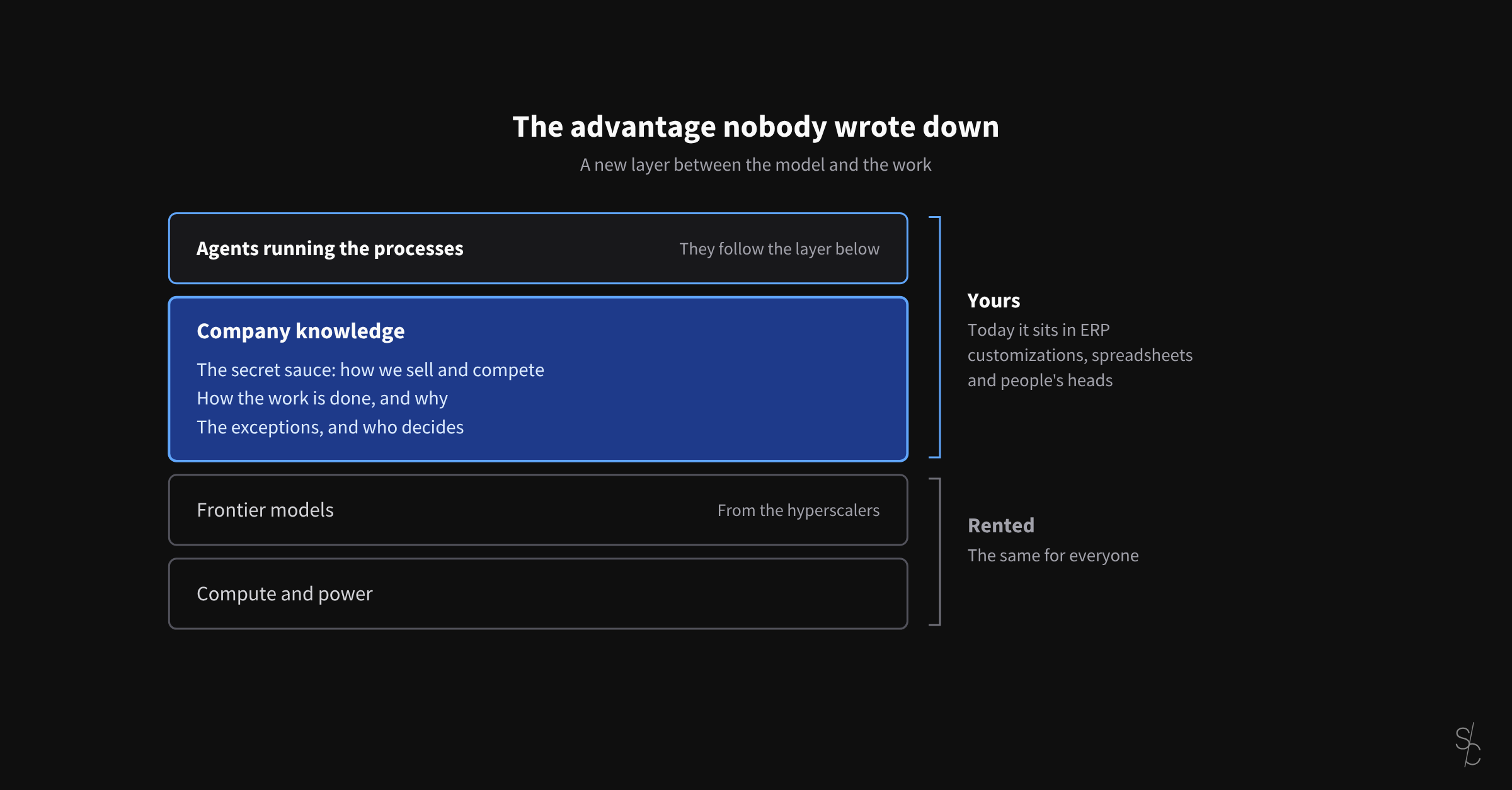
Nyström, a former Accenture managing director now building a startup, gave the direction a name. Company knowledge that sat in systems and in people's heads is being condensed into AI systems that can do the business. That makes a new layer in the stack. It's the layer where he'd have Europe build its moat, on its deep industrial knowledge, and use the other layers as they come.
I'd say the same of a single company. This layer is its own. The layers below it can be rented.
What the layer looks like up close
Anthropic's data team has built a small version of this layer for its own analytics, and measured what it does. An agent pointed at the data without it gives answers that look precise and mostly aren't: accuracy "didn't exceed 21%" without curated context, reached about 95% with it, and drifted to about 65% in a month when nobody kept the context up.
Up close the layer is unglamorous: rules, definitions, and a few checked tools for the questions that repeat, written by the people who own the numbers.
I think that scales from one report to the whole company, and that writing it is the main work of the next few years. I'd do it process by process, starting with the three Lundmark asked for.
Each step needs more written down
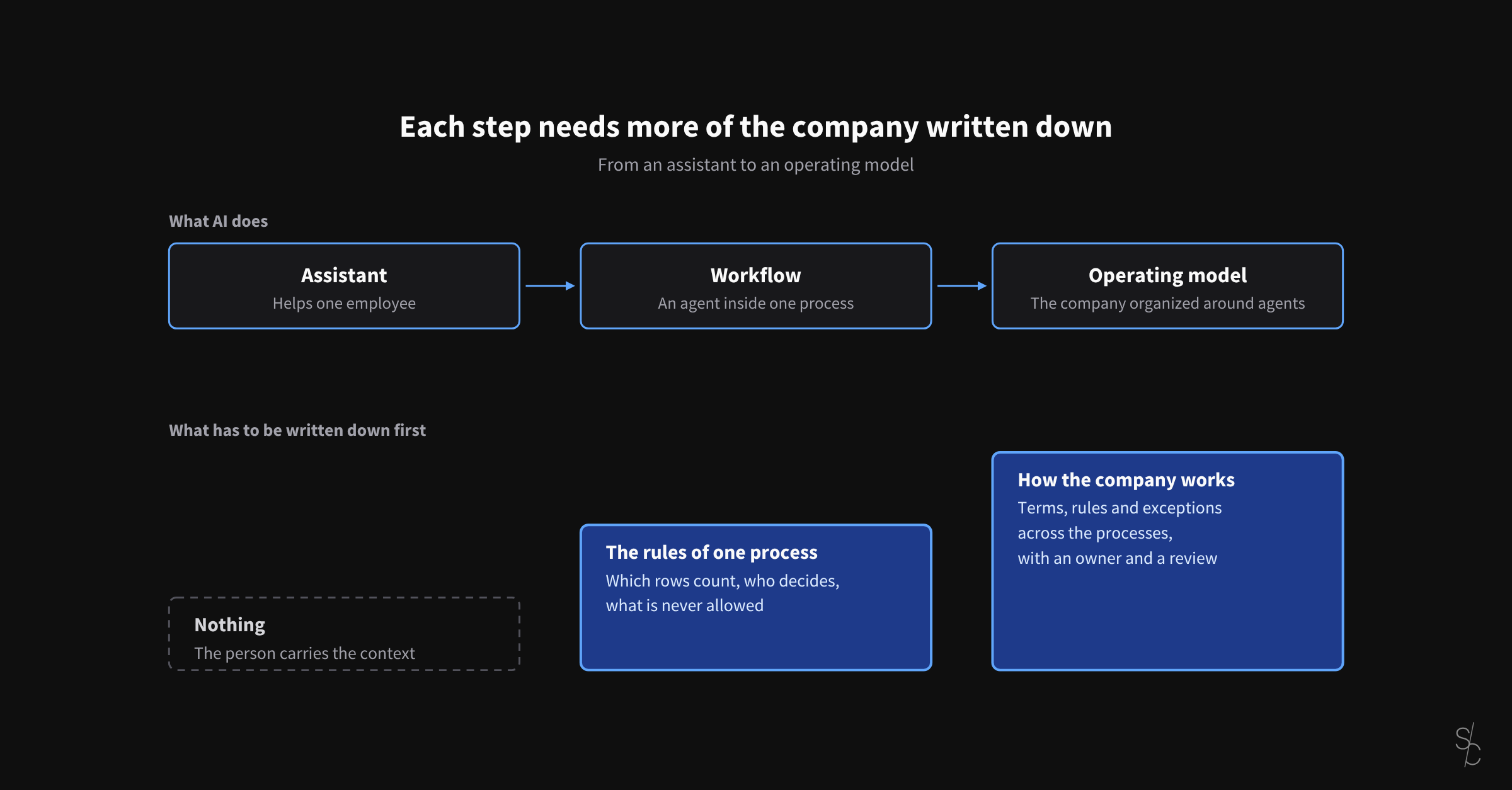
Ritakallio, the CEO of OP Pohjola, described the path. AI moves from a tool that assists an individual employee, to something embedded in workflows and processes, and eventually to entire operating models. The question, he said, isn't how to introduce AI into the existing organization. It's how to redesign the organization around what AI makes possible.
Read with the missing manual in mind, each step needs more of the company written down. An assistant for one person needs nothing, because the person carries the context. An agent inside a workflow needs the rules of that process. An operating model needs how the company works.
I think this explains the numbers. The first step is the only one a company can take without writing anything, so that's where most of them stand.
When the process is a document
Nyström described how change works today: a project designs, builds, tests and deploys a system, and then it runs mostly unchanged. Systems that pursue a goal on top of the company's own knowledge can run a process and change it while it runs. He asked whether "change is hard", the consultant's saying, will still be true in five years.
My answer is half. When a process is described in a document an agent follows, changing the process starts to look like editing the document. That half gets cheap.
The human half doesn't. Lundmark was blunt about large organizations: four layers of management are asked to change something, many of them aren't comfortable with the technology, and many are afraid for their own jobs. That's why he wants a small team working from zero, outside the existing organization, with the CEO protecting it.
Nyström also raised what comes next: how to govern this layer, how to protect it, and what sovereignty means for it. I expect companies to treat it the way they treat the chart of accounts, with a named owner, versions, and a review before anything changes. I'd also keep it in a form the company owns, plain documents rather than one vendor's settings, so the model underneath can be swapped.
Small companies, and Europe
I think this wave suits them better than the number suggests. There are fewer layers of management, and the owner often knows the whole process, so the manual is shorter. Lundmark said he has seen five to ten talented people build, in a few months, something that could challenge large established players in a sector. A small company that writes down how it works can behave like that team.
For Europe, Lundmark split one race into two. The model race gets the headlines, and the deployment race decides who gets the productivity. No customer ever paid him for owning the most advanced technology. "They paid us for what the technology did in their operations." The frontier models will keep coming from the hyperscalers, and we should use them.
The deployment race needs buyers. Saarenmaa, the CEO of Aiven, said it's easier today for a European startup to sell to US enterprises than to European ones, so the products get built to someone else's needs. Lundmark asked the leaders in the room to become the first customer of a European AI company, and to co-create with it instead of sending it through procurement.
In the picture above, the bottom layers are the same for everyone. The knowledge layer can't be imported, because it doesn't exist until the company writes it.
How I start
This is the order I've been doing process design in.
- Connect an agent to the ERP. A Model Context Protocol (MCP) server gives it access to the data. That shows what's there, and what's elsewhere and has to be written into the manual.
- Build APIs on the ERP. They let software read and write, and take action. New applications on top of the ERP still steer the old processes, and now they start to hold the missing manual too.
- Then improve the process, with AI embedded like the people are. Quality, lead times and productivity come first. Then the things Ritakallio asked for beyond efficiency: growth, a better experience for customers and employees, and business that didn't exist before. This is where the competitive advantage grows, and where the earning starts.
- Start small. Give the team autonomy and a mandate, and iterate fast.
- Start where the work is. The change will still be hard. Begin the journey from where people are doing the work today.
That's the gentler road. The more ambitious one is Lundmark's: start from zero, with a team outside the existing organization. It goes further, and the change management is more painful. In some cases, to move fast enough, I think it's the only approach.
The manual
Lundmark closed by saying Europe may not write the first chapter of the AI story, but the chapter that matters for productivity is the one about putting AI to work, and it's being written now.
For a single company, I think that chapter starts with a duller book. The models are the same for everyone, and the power comes off the same grid. The manual for how this company works is the one part nobody else can write, and in most companies nobody has written it yet.
Links
On the panel:
- AI Summit | 16.11.2026 | Turku Finland
- Yle Areena: AI Summit 2026
On using AI and earning from it:
- Eurostat: Use of artificial intelligence in enterprises
- BCG: The Nordic AI Inflection Point: Value Creation or Value Bubble?
- OP Pohjola: Survey: Only 11% of Finnish companies are using AI strategically, however, investments are growing
On company knowledge:
More from the blog
The data warehouse shrinks to a document
An agent connected straight to the ERP answers the one-off question in minutes. What it still needs from the data warehouse isn't the plumbing. It's the meaning.
In open source, the code is the cheap part
Agents can rebuild a code base from its test suite. They can't copy the people who answer for it.
We still price software with a pre-agentic cost model
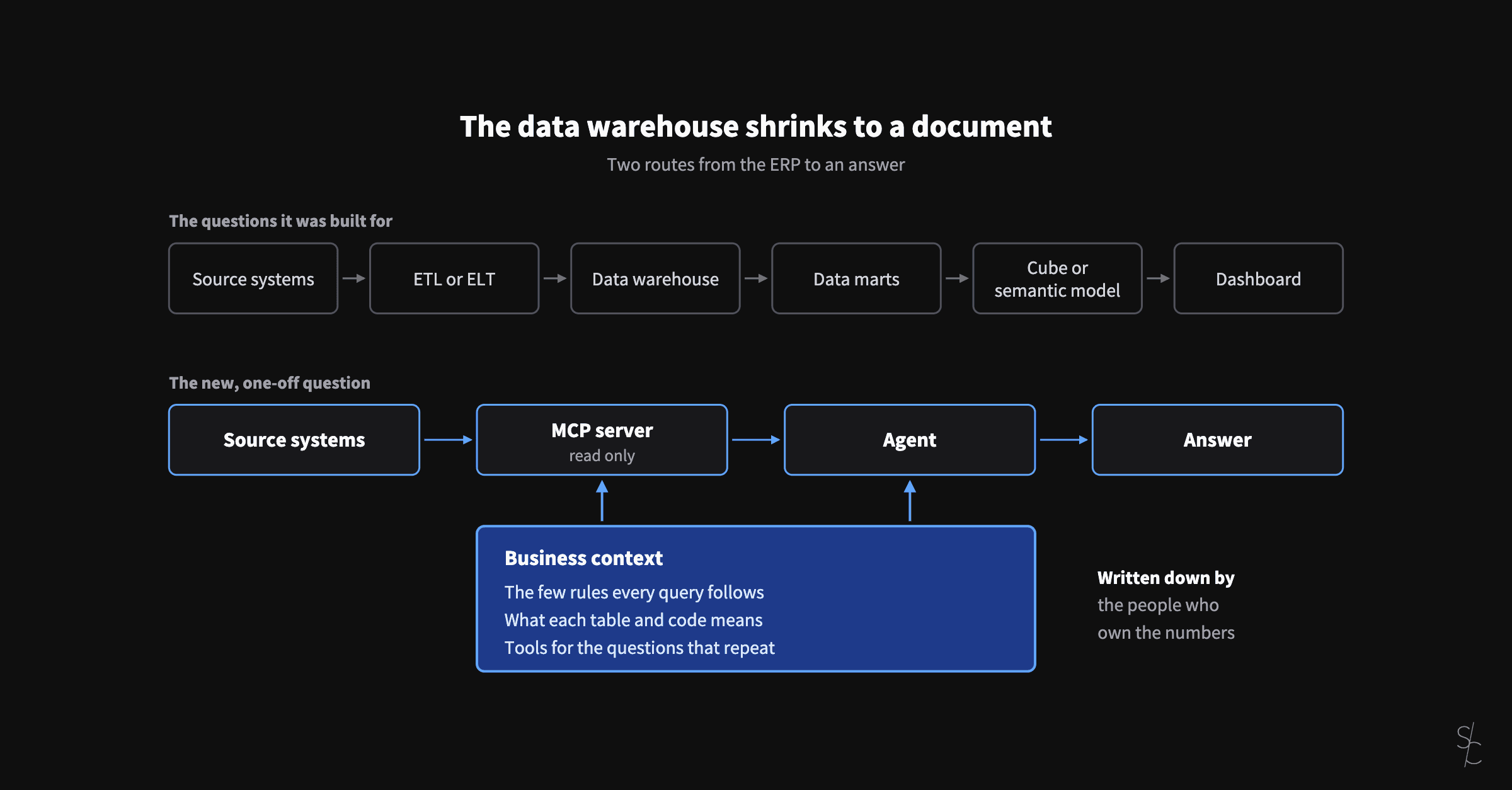
Five prices in software changed at once. Building got cheap. Checking didn't.